The True Cost of Underbidding a Job (And How to Avoid It)

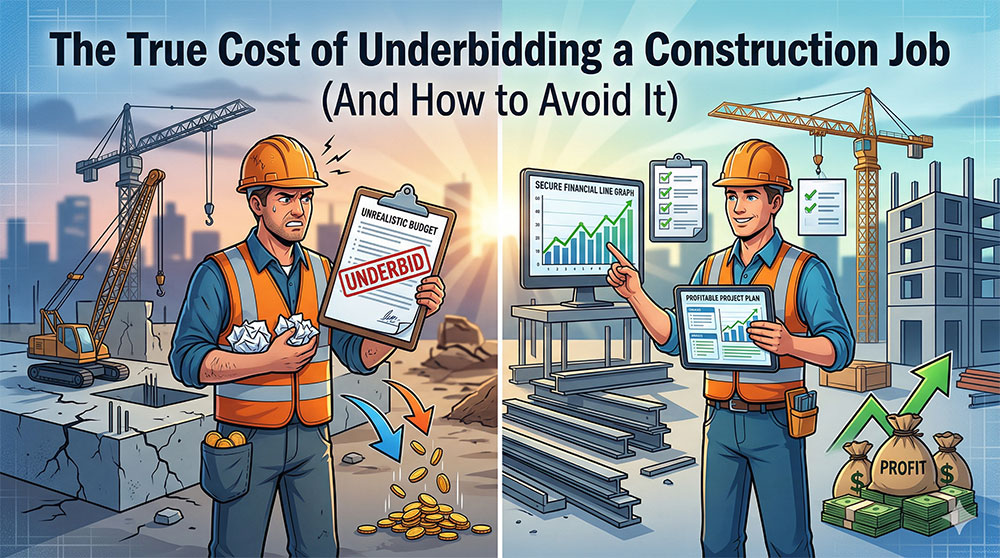
You won the bid. Congratulations — except, by the time the job wraps up, you’ve barely broken even. Sound familiar? For many small contractors, underbidding isn’t just a one-time mistake. It’s a pattern that quietly drains the life out of a business.
Let’s talk about what underbidding actually costs you and what you can do about it.
Why Contractors Underbid
Underbidding usually comes from one of three places: fear, guesswork, or habit.
Fear is the most common culprit. When work feels slow, it’s tempting to sharpen your pencil just to land the job. Guesswork happens when you’re estimating from memory instead of real numbers, relying on gut feel rather than actual labor hours and material costs. And habit kicks in when you’ve always bid a certain way, never stopping to check whether it’s actually working.
None of these are character flaws. They’re understandable responses to a competitive, unpredictable industry. But the financial damage they cause is very real.
The Costs You’re Probably Not Counting
Most contractors know to include materials and labor in a bid. But underbidding often comes from forgetting or underestimating the costs hiding beneath the surface.
Overhead. Every hour your crew works, you’re also paying for insurance, fuel, equipment wear, office expenses, and your own time managing the job. These costs don’t disappear just because you forgot to include them in the bid.
Labor burden. The actual cost of an employee isn’t just their hourly wage. Add payroll taxes, workers’ comp, and benefits, and you can easily be paying 25 to 35 percent more than the base wage. Bid the wage and eat the burden.
Scope creep and surprises. When your bid is already razor thin, any unexpected issue like a buried pipe, bad weather, or a subcontractor delay can push you into the red. A properly priced job has room to absorb the unexpected. An underbid job does not.
Your own time. How much is your time worth? If you’re spending 10 hours managing a job and didn’t account for that in the bid, you’re essentially working for free.
The Real-World Impact
Here’s what makes underbidding so dangerous: it doesn’t feel catastrophic right away. You stay busy. Invoices go out. Cash comes in. But profit? That’s quietly bleeding out.
Over time, underbidding trains clients to expect low prices. It burns out your crew when corners get cut to save money. It prevents you from investing in better equipment, better people, or better systems. And eventually, it can sink a business that looks busy and successful from the outside.
How to Stop Underbidding
Know your numbers before you bid. That means tracking actual costs on every job, not just what you estimated but what it really cost. Over time, this builds a reliable picture of what your work actually takes.
Build in overhead on every bid. Calculate what your monthly overhead costs are, then spread that across your billable hours. Every job needs to carry its share.
Stop competing on price alone. Clients who only care about the lowest number are often the hardest to work with and the least profitable. Win on reputation, reliability, and quality and price your work accordingly.
Use software that does the math for you. Tools like ProfitDig are built specifically for small contractors to create fast, accurate estimates that include all your real costs, so you stop guessing and start bidding with confidence.
The Bottom Line
Winning a job that loses money isn’t winning. It’s just a slower way to lose. The goal isn’t to be the cheapest contractor in town. It’s to be a profitable one.
Get your numbers right, bid your worth, and watch your margins grow.
Ready to start bidding smarter? Try ProfitDig free for 30 days and see how easy accurate estimating can be.
Stop losing profit.
Build bids in minutes and track every dime with ProfitDig.
Start Risk-Free30-Day Money Back Guarantee